


Small Things Like These


There are films that scream their message at you. Films that rely on spectacle, explosive confrontation, or emotional manipulation to force you into feeling something. Then there are films like Small Things Like These. Films that very quietly whisper to you what they want to tell you. Films that sit in silence and ask you to just listen. And somehow, those are often the films that haunt you the longest.
This is one of the quietest films I have seen in years, and yet emotionally... loud!
Directed by Tim Mielants, whose workI have to admit I am not too familiar with, and led by an incredible performance from Cillian Murphy, Small Things Like These is not just a story about complicity. About the silence that allows evil to survive in our communities and society. About ordinary people who know something is wrong but convince themselves that survival matters more than intervention.
And what makes this film brilliant is that it never approaches these themes in a loud or dramatic way. Everything about the film is totally restrained. The direction. The performances. The cinematography. Even the pacing feels deliberate. It sort of traps you inside Bill's mind and forces you to sit with his loneliness, his trauma, and his internal moral battle.
Story & Themes
At its core, Small Things Like These is a deeply human story disguised as a quiet historical drama.
Set in a small Irish town controlled heavily by the local convent, the film follows Bill Furlong, a coal merchant and father who accidentally uncovers the abuse and mistreatment of young women inside the convent. The institution itself has strong control over the town almost like a shadow government. Everybody knows its power. Everybody understands the social consequences of speaking against it. And because of that, everybody stays silent.
That is what this film is truly about. Not simply corruption. Not simply evil. But the system of complicity that allows 'evil' to survive. The film asks us the question: "If you knew injustice was taking place around you, and you had the power to do something about it, would you risk your own stability to act?"
Most of us probably imagine that in such moments, we would be courageous. This film quietly tells us what we know, that most of us... wouldn't. Bill himself is not some naturally heroic man. He is not rebellious. He is not outspoken. He is not confrontational. He is a deeply passive man who has spent his entire life surviving emotionally rather than truly living. He keeps his head down. Provides for his family. Avoids conflict. Suppresses emotion. He has learned this behaviour since childhood.
And that is why his journey feels so powerful. Because this is not a story about a fearless man doing the right thing. It is about a frightened man trying to overcome a lifetime of emotional repression and moral paralysis.
The film also explores inherited trauma in a remarkably subtle way. Bill’s childhood memories quietly bleed into the present throughout the film. His loneliness as a child never truly left him. It shaped the entire architecture of his personality. He became a man incapable of expressing his pain outwardly. A man emotionally imprisoned within himself.
There is an overwhelming sadness to this film because Bill constantly feels disconnected from the world around him. Even surrounded by family, friends, and community, he feels emotionally isolated. Like he is drifting through life rather than participating in it.
And the brilliance of the screenplay is that it trusts silence. It trusts the audience to feel what Bill cannot verbalise.
Character & Performances
Cillian Murphy as Bill Furlong. In my personal opinion, this is one of the best performances of the decade. Not because of emotional monologues or transformative physicality, but because of restraint. Very few actors understand stillness the way Murphy does.
Most actors, when portraying pain, externalise it. They cry loudly. They erupt emotionally. They project suffering outward. Murphy does the complete opposite. His performances feel like watching someone desperately trying to contain emotion before it leaks out against their will. That is exactly who Bill Furlong is. A man carrying decades of sadness internally. A man who never learned how to express grief, loneliness, anger, or fear. Everything remains trapped beneath the surface. Cillian Murphy communicates all of this almost entirely through his piercingly blue eyes. There is a scene of Bill in the barber’s chair that absolutely destroyed me emotionally. On paper, it is an incredibly simple scene. Quiet. Still. Almost no dialogue. But it contains more emotional truth than entire films do in their runtime. You watch Bill sitting there trying with every fibre of his being to maintain control over himself. Trying to keep all that pain locked inside. And then slowly, almost imperceptibly, it begins to surface. Tiny shifts in the eyes. Slight tension in the face. Subtle tears beginning to form.
It is extraordinary acting because Murphy understands that real grief often does not explode outwardly. Sometimes it simply leaks. And the camera understands this too. The film constantly frames Bill in ways that emphasise emotional imprisonment. Tight close-ups. Isolated compositions. Doorways and windows that visually trap him. Murphy’s face becomes the emotional landscape of the film itself. Another phenomenal scene is the gathering sequence where Bill is surrounded by people yet feels completely alone. This scene perfectly captures the emotional language of the film.
The sound softens. The framing isolates him from others. The camera lingers just long enough to make you uncomfortable. You feel detached from the room alongside him. It becomes less about literal loneliness and more about existential loneliness. Murphy gives Bill an almost ghost-like presence throughout the film. He moves through scenes as though weighed down by invisible emotional gravity. I genuinely cannot think of another actor currently working who could perform this role with such precision and emotional intelligence.
Cinematography & Visual Storytelling
The cinematography in Small Things Like These is extraordinary because it understands something many modern films forget: Visuals are not there simply to look beautiful. They are there to communicate emotional truth Every technical decision in this film feels emotionally motivated. The camera placement, lens selection, lighting, framing, movement, texture, and use of negative space are all working together to place us directly inside Bill Furlong’s psychological state. The film does not merely show us his loneliness and repression. It makes us physically feel it.
What I loved most is how restrained the visual language is. There is no visual arrogance here. No desperate attempt to show off cinematic technique. The cinematography serves character first at all times. It understands that stillness can often be more emotionally devastating than spectacle.
Use of Space and Environment
One of the most brilliant aspects of this film is how physical environments are used to emotionally imprison Bill. The town itself feels spiritually suffocating. It is cold, muted, rigid, and emotionally closed off. Even outdoor spaces rarely feel freeing. Streets feel empty. Buildings loom over characters. The convent itself feels less like a religious institution and more like a silent fortress of control.
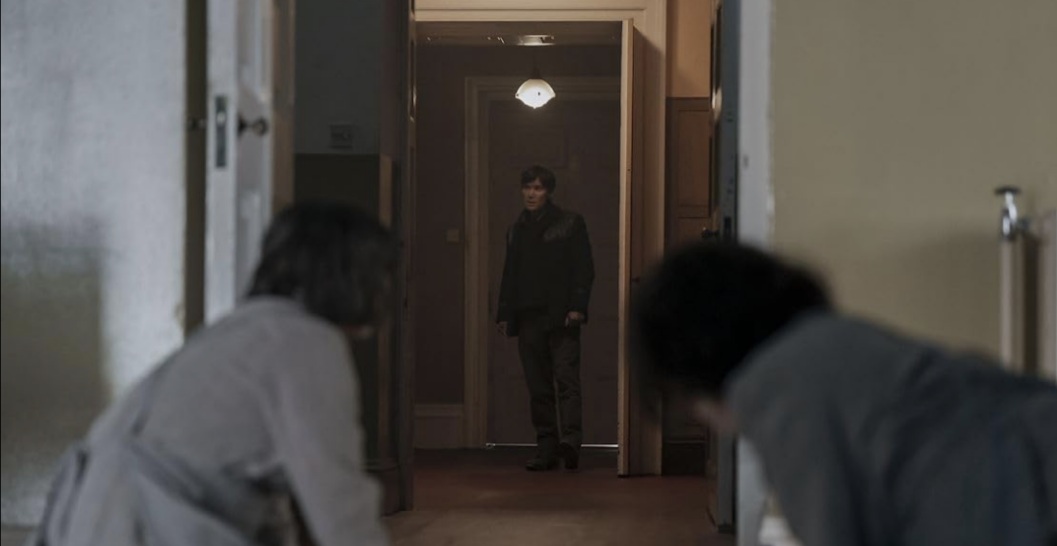
Bill is constantly framed within oppressive environments. Doorways, narrow hallways, windows, staircases, and cramped interiors repeatedly box him into the frame. There is a recurring visual motif throughout the film where characters are separated by physical barriers, whether that is glass, shadows, walls, or depth within the frame. The visual language constantly reinforces emotional separation. The environment reflects the social structure of the town itself. Everybody knows the truth. Yet the entire town functions around silence and suppression. The spaces themselves begin to feel complicit.
One thing I especially loved was the way crowds are used. There is a phenomenal scene at the social gathering where Bill feels completely emotionally disconnected despite being surrounded by people. The blocking and staging in this scene are masterful. Characters move around him almost like ghosts while the camera subtly isolates him spatially from the group. The room is technically full, yet emotionally empty.
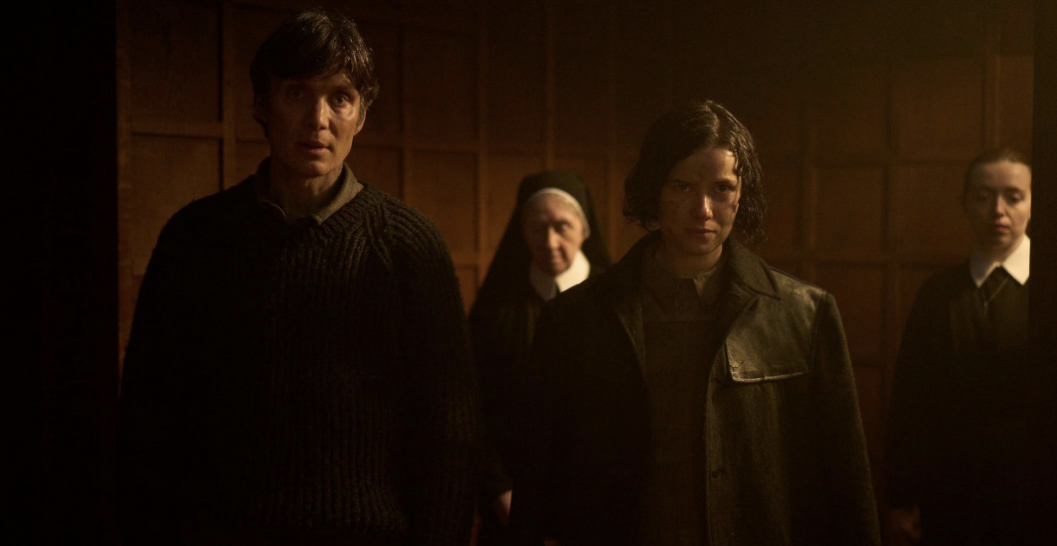
This is something great filmmakers understand deeply. Loneliness is not about physical isolation. It is about emotional disconnection. The cinematography captures that perfectly. The convent sequences are also visually fascinating because the architecture itself feels authoritarian. Hard lines. Heavy shadows. Long corridors. Closed doors. The spaces feel designed to suppress individuality. Even before dialogue reveals the horrors taking place, the environment already communicates institutional control. This film understands environmental storytelling at an elite level.
Cameras and Lensing
While the exact technical package matters, what matters more is why those tools were chosen The film appears to favour restrained camera movement combined with intimate lensing choices that prioritise emotional proximity over visual spectacle. Much of the film feels shot with medium to longer focal lengths, particularly during Bill’s close-ups. This compresses the background and subtly traps him within the frame.
That compression is psychologically important. Longer lenses reduce spatial freedom. The world feels tighter around Bill. Backgrounds blur away into abstraction. He becomes emotionally isolated from his environment even while physically inside it. And then there are the close-ups. This film understands the power of holding on a human face. The camera repeatedly lingers on Cillian Murphy in ways that feel almost invasive emotionally. Not flashy close-ups. Not melodramatic framing. Just patient observation. And Murphy rewards that patience completely. His face becomes the storytelling device itself. You can tell the filmmakers deeply trusted Murphy’s ability to communicate internally because the camera rarely forces emotion through aggressive movement or editing. Instead, scenes are allowed to breathe. The lens simply observes him processing pain in real time.
The barber chair scene is the perfect example of this philosophy. The lens stays close enough for us to notice microscopic emotional shifts in Murphy’s eyes and facial tension, but never so close that it becomes performative or manipulative. The restraint is what makes it devastating. I also noticed how still much of the camerawork is. The film rarely uses dramatic handheld movement or kinetic energy. That lack of movement creates emotional heaviness. Bill feels emotionally stuck, and the camera language reflects that paralysis. When movement does occur, it becomes meaningful.
Slow tracking shots often feel ghost-like, almost as though the camera itself is drifting through memory or buried trauma. This creates a dreamlike emotional atmosphere throughout the film. The likely choice of vintage or softer lenses was also incredibly smart because the image has an organic texture to it. Nothing feels clinically digital or hyper-sharp. The softness in the image creates emotional fragility. Skin tones, low light, and shadows blend together naturally in a way that feels tactile and melancholic. That texture matters enormously in a story like this. A cleaner, sharper visual style would have emotionally betrayed the material.
Lighting, Colour, and Texture
The lighting in this film is astonishing in its restraint.
Much of the film feels lit through naturalistic sources such as windows, lamps, practical interior lighting, overcast daylight, and candlelight. This grounded realism is crucial because the film is emotionally intimate. Artificially stylised lighting would have weakened the authenticity. Shadows dominate the visual language. Faces frequently disappear partially into darkness. Rooms feel underlit. Corners fall away into blackness. This does two important things psychologically. First, it creates emotional heaviness and unease.
Second, it visually reflects hidden truths and suppressed pain. The town itself feels morally shadowed. The colour palette is incredibly controlled. Cold greys, faded greens, dark browns, muted blacks, and winter blues dominate the frame. Warmth is almost entirely drained from the image. Even domestic interiors rarely feel comforting.
That lack of warmth becomes emotionally devastating because Bill’s world feels spiritually cold long before we consciously process it intellectually. The texture of the image also deserves huge praise. There is an organic softness throughout the film that feels almost photographic rather than digital. Grain, softness in shadows, and low-light imperfections give the film emotional tactility. The world feels lived-in, worn down, exhausted. Which is exactly what Bill himself feels like internally.
I also loved how the film avoids visual glamour entirely. Even beautiful shots often feel emotionally mournful rather than aesthetically indulgent. The cinematography never romanticises suffering. Instead, it quietly observes it. And that restraint is precisely what makes the film haunting.
Direction & Pacing
Tim Mielants understood restraint, in this film, better than most modern directors are capable of. Silence is quite rare in modern films. Exposition is loud and too often. Directors constantly feel the need to explain emotion, accelerate pacing, or overstimulate audiences visually and sonically.
This film does the opposite. It trusts atmosphere. It trusts performance. It trusts visual language. And because of that, the emotional impact becomes devastating.
The direction here is incredibly disciplined. Mielants never sensationalises the abuse or turns the story into melodrama. Lesser directors would have pushed this material into overt emotional manipulation. This film remains restrained almost the entire time. That restraint is exactly what gives the film its power.
The emotional tension builds quietly underneath every interaction. Every conversation feels loaded with things left unsaid. You constantly feel the weight of the town’s collective silence. The pacing is deliberately slow, but importantly, it is purposeful slowness. The film wants you to exist within Bill’s emotional rhythm. His exhaustion. His silence. His internal conflict.
There is immense confidence in direction like this because it risks alienating audiences who require constant stimulation. But for viewers willing to surrender themselves to the film’s rhythm, the emotional payoff is extraordinary.
Emotional & Intellectual Impact
This film stayed with me long after it ended. Not because it shocked me, but because it quietly unsettled me.
It forces the audience to confront uncomfortable truths about morality and social complicity. Most evil systems throughout history did not survive purely because powerful people existed. They survived because ordinary people looked away. And the terrifying thing is that the film never presents Bill as fundamentally different from everyone else. He is ordinary. That is what makes his moral dilemma feel so real.
The film also deeply affected me emotionally because Bill’s loneliness feels painfully authentic. There is something devastating about watching someone who has emotionally suppressed themselves for so long that they barely know how to connect with the world anymore. This is not just a story about institutional cruelty. It is also a story about emotional imprisonment. And I think many people will recognise parts of themselves in Bill Furlong.
Closing Thoughts
Small Things Like These is a masterclass in restrained and subtle filmmaking. It is haunting, devastating, and deeply human. This film questions humanity. It confronts us about who we are as a society. It provokes. Through subtle performances, patient direction, suffocating atmosphere, and extraordinary visual storytelling, the film creates an experience that feels really emotionally immersive..
And at the centre of it all is Cillian Murphy delivering possibly one of the finest performances of his career, or at least my favourite performance of his. A performance built not on theatricality, but on silence, stillness, and emotional truth. This is cinema operating at a profoundly mature level. A film about quiet complicity, buried trauma, and the terrifying cost of moral silence.
My Favourite Frames






Old age should burn and rave at close of day;
Rage, rage against the dying of the light.” ❤️


